Sunday, December 6, 2009

(Eye)nspiration against (I)mitation...


"The world of “new music” is not the esoteric, marginalized place that it used to be. Now that there are more composers who have actually found some success and made some money, there is a clearer career path. Avoid that path — you already know where it leads. The composers you admire didn’t get where they are by imitating others. Inspiration and influence are a far cry from imitation, so listen, observe, and then dig deeper to find your own music."

from composer Annie Gosfield's op ed piece in the NY Times.

Thanks to those who came to both performances of Parlour Games.

Tuesday, November 24, 2009

Parlour Games at The Tank Dec 4 and 5


December 4 and 5, 2009
Parlour Games
Choreography by Tze Chun
Original Score by Chris Becker
@The Tank
354 West 45th Street (between 8th and 9th Avenues)
December 4 and 5, 2009
9:30 pm
Admission: $12

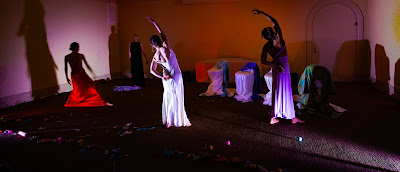
Parlour Games is a collaboration between myself and choreographer Tze Chun. The choreography is inspired in part by Victorian era parlour games as well the architecture and environment of late 19th century / early 20th century New York City.

The music for Parlour Games is mainly piano with the harmonic, rhythmic (definitely rhythmic), and melodic language coming from some of my favorite composers - Debussy, Satie, Louis Moreau Gottschalk, Scott Joplin, even a little bit of Mahler. The score is prerecorded, and features my good friend Daniel Kelly on the keys. While some of the performances are straight forward, others have been processed and edited to create some truly crazy cut-up textures. The challenge for me was to create a consistent thread throughout the pieces - a vibe that evokes the Victorian era and parlour games that inspired Tze's choreography.

I've also utilized a lot of Foley-like sounds (my own recordings) including the creaking stairs and slamming doors of a six unit turn of the century building as a part of the mix.

Hope some of you can come check this out. Have a great holiday.

Wednesday, November 18, 2009

Wish You Were Here


Douglas Henderson's Music for 100 Carpenters at The BOILER. Photo by David Henderson (from atop the boiler!)

The installation version of the piece (which includes video shot from above with wide angle lens capturing the performance AND a five channel surround mix of the piece) is up at The BOILER until December 20th. BOILER hours are Wed. - Sun., noon - 6pm, 191 N. 14th St. Williamsburg, Brooklyn (bet. Berry and Wythe)

Saturday, October 24, 2009

Interview with Douglas Henderson


Interview by Chris Becker
Right Photo: Composer Douglas Henderson

To complete my triptych of interviews that began back in September with author Ned Sublette followed by saxophonist, composer Matana Roberts, I bring you an interview with my friend composer Douglas Henderson. I am participating in a performance of Doug’s Music For 100 Carpenters next month (November 7th and 8th, 8pm, at Peirogi Gallery's BOILER space in Williamsburg, NY) and I thought an interview about the piece would interest and provide a "way in" for those unfamiliar his work.

Douglas Henderson's work straddles a line in between the categories of music, sculpture, and dance and theater. He has presented works at the Whitney Museum at Altria, Dance Theater Workshop, and PS122 in New York and at Inventionen and daadgalerie in Berlin, among many others. Doug describes Music For 100 Carpenters as “a theatrical surround-sound music performance, enlisting 100 skilled and unskilled tradespeople. Prying at Stockhausen’s convolution of rhythm and timbre, 100 hammers, 100 blocks of wood and some 10,000 nails of varying sizes are brought to bear in a real-time, real-world articulation of complex computer synthesis. Under the guidance of job supervisors, thousands of hammer blows become waves of tonal murmur, threaded with rustlings of nails and occasional snarls of righteous indignation. The performers are organized into work crews with lists of tasks and closely timed schedules, and arranged in a circle around the audience. Toolbelts, sweat and lunchboxes are part of the score.”

If you are interested in participating in one or both performances of Music For 100 Carpenters, you can email me, leave a comment, and/or visit the 100 Carpenters website.

Chris Becker: In performance, Music for 100 Carpenters generates an incredible dynamic range of sound. What you yourself describe as a “limited sonic palate” (i.e. hammering nails, shaking bags of nails, opening and closing lunchboxes, etc) actually generates sounds that transcend their humble origins. As a composer, do you yourself hear the potential for all manner of expression from the “non musical” sounds of tools, household objects, and/or the natural world (rain, wind through leaves, etc)?

Douglas Henderson: I generally work with base source material; partly because it is much more susceptible to surprising transformations (especially in this technique of multiplication, which I'm much taken with), and partly because it inevitably has a heavier psychological wallop. Working with the stuff we all grew up with, from birth, affords a lot of suggestion, which, manipulated, becomes a strong part of the subject matter of the composition. Psychology, or more phenomenology, is something that can be played with on the level of musical composition, and that fascinates me.

CB: There’s a spatial component to Music for 100 Carpenters that is hard to explain on paper. In your description of the piece, you write “… (it) unfolds as a moving sculpture, using sound to tilt the architecture of the venue.” The audience is more or less surrounded by the carpenters and the sounds they’re producing over the course of the piece. Other works of yours that I’m familiar with – multichannel compositions using prerecorded sounds – are played to listening audiences seated in concentric circles facing outwards with several speakers placed around perimeter of the venue. Is your use of space (spaces?) – i.e. where the individual sounds occur and where the listeners are located –a means for sensitizing your listeners’ ears to sound?

DH: I would say that tuning the listener is a central part of the work, both in terms of space and sound. Maybe this is one of the things that distinguishes the identity of the thing, and perhaps defines it outside the realm of music (but maybe not...).

In this piece the carpenters are arranged around the audience, in 10 groups, so I have in some way a 10 channel surround system (with considerable slop, as I don't expect any sort of precision of execution from the mass of carpenters). I would love to put the audience in concentric circles, as this maximizes the dimensional imaging, but we don't have space in the gallery, and the audience will be in 2 sets of rows facing opposite walls, the best compromise I can manage. In this piece, space, location, direction and sonic architecture are nearly the totality of the composition. Each performer can make only a few sounds, and while the multiplication of those sounds is a large part of the magic trick, the main is about location, mass, volume and so on. "Where is it? How thick is it?", these are the things I'm trying to get the people to perceive as variables for composition, and to experience the organization of time in those terms.

CB: Music for 100 Carpenters began as a prerecorded work overlaying several tracks of the sound of one person hammering nails. Since then, the piece developed into a live performance using as many as 50 people. And November 7 and 8 at Peirogi Gallery, you have 100 people (carpenters) on hand to perform the piece. What are some of the qualities to the live performance of Music for 100 Carpenters that you could never realize in its original prerecorded single carpenter version?

DH: The recorded version was actually only an accidental discovery, when a “solo” button was inadvertently released and something strange came out of the speakers. From hearing one person pounding some nails into a board I suddenly heard 40, and the sound was completely transformed, I could no longer recognize the source. The piece was born at that instant. I then used the canned version as way to compose the 50 carpenter piece, which was never intended as anything other than a proof-of-concept, i.e. that the same magic trick could take place in the real world. I was always shooting for the 100 carpenter version, but never had the venue or the money to make it happen until now.

The piece is designed as a set of orders, or scheduled tasks, in the same way that a large construction site is organized. No one has the complete picture, everybody just puts their heads down and does their bit of the work; somehow a building emerges out of all that unknowing, and all that lack of communication between the trades, the architect, the general contractor. I thought this was an interesting set of boundaries for a score. The live iteration, fraught with error, unpredictable following times and so on, completes the thing, or corrects its inherent clumsiness, because the commands possible in the score are very clumsy. If everybody performed exactly what is on the paper it would be kind of blocky (as is the recorded sketch), like a low bit-depth digital converter; the human element is a kind of “dither”: noise introduced to make the signal clearer.


CB: There’s a quote from the painter Piet Mondrian at the beginning of composer Morton Feldman’s essay “Crippled Symmetry”: “I enjoyed painting flowers, not bouquets, but a single flower at a time, in order that I might better express it’s plastic structure.” I immediately thought of your multi-channel piece (pages of illustrations) which uses thousands of recordings you made of brushing two leaves together to realize a multi-tracked, complete and leafy “tree." What did this recording process – similar to Mondrian painting a single flower at a time to create a bouquet – reveal to you in terms of structuring an imagined tree?

DH: A slightly lateral reply: I’m doing some sort of granular process in these pieces. But where the definition of granular synthesis assumes (or perhaps mandates) that the grains have no particular identity, I am interested in putting an individual face on every grain. So for example, in (pages of illustrations) I made hundreds and hundreds of individual recordings of brushing the leaves together - in some way I was getting to know the tree one leaf at a time.

I see the algorithms used to manipulate grains streams and clouds as some form of government - you make a law and many people will follow it, to some extent. It can be something rather minor, like, “don’t spit on the sidewalk”. Some people will disobey, but you will see a citywide trend of less slime on the walkways. This is my metaphor for granular synthesis; and it then becomes interesting to zoom in on individual grains, to give them some meaning in their legal structure. Music for 100 Carpenters is very much involved in this metaphor, with a simple set of rules and hierarchies guiding the performance, and the individual sounds and micro-rhythms being very recognizable, until they form a cloud mass and take off.

CB: You describe Music for 100 Carpenters as “Prying at Stockhausen’s line between rhythm and timbre…” You lived and created work in New York City for a long time before relocating to Berlin, Germany. I realize I’m generalizing here, but what sort of reaction are you getting from Berliners when they hear and/or see your work? Is anything lost in the translation? Or are there elements that they respond to more immediately than New Yorkers?

DH: Europe, as has been observed by many more eloquent observers that I, is different. Morton Feldman said, “..in Europe, if you have a job, you’re an amateur.” This is very true, and makes it hard to perform Music for 100 Carpenters over there, because the piece is so much about this very American flexibility in the labor market. Almost every artist or musician I know in New York has at one time or another been a carpenter to make some extra dough; the piece is largely a tribute to those “tool bag days” which are familiar, not just to artists. In Germany, every profession requires a training period of 2 - 3 years before one is permitted to practice; paperwork, licenses, insurance and so on. So people don’t do a lot of different jobs, and if you declare yourself a composer or artist it is somewhat shameful to admit that you have another source of income (though most people do...). The effect on people’s perceptions is substantial, and I bump into some incredulity when I tell people that I actually make my own sculptures, do my own audio engineering, compose music and tie my own shoelaces. One curator said to me, “it is not possible that you can be really good at such different tasks. You must choose one, and only one, field.” (He has since lost his job and is frantically struggling to find a way to pay his rent, with his one, and only one, skill).

So there is a lot of skepticism of Americans for that reason, and also a lot of interest, because Americans are apt to approach problems very differently. Discussing (pages of illustrations) with a group of mainly German electroacoustic composers at the Technischen Universitaet, someone asked me, “What is the structure of the piece?” (I think he was worried that there wasn’t any - a cardinal sin of course). I hadn’t really approached the work from that angle. I was more concerned with the conceptual/perceptual problems. But the answer was very simple, and I said, “The structure is the wind.” The man was clearly hoping for something less poetic, and I had to explain that I studied a particular 14 minute stretch of wind gusts I had recorded, analyzing them for speed, acceleration, pitch alteration in my ear canals, how leaves react at the windward and leeward edges of a tree, etc. That map became the score for the piece. He was shocked - it wasn’t in his way of thinking at all. He wanted something rigorous, or he wanted me to fail - it never occurred to him that a structure could be both rigorous and completely outside his analytical framework. I had to repeat my magic formula three times before anyone would believe me. Then we all had a good laugh.

Mind you, I don’t see these differences as negative in any way, they are just differences. And I think my success in Germany is partly down to the alienness of my background. The corollary to Feldman’s observation is that in America, artists are regarded as dangerous slackers who refuse to get a real job; while Europeans view the calling as a noble one and they have great respect for the sacrifice and effort required. A cop at the German passport control asked me what I was doing in Germany, and I replied that I am a sound artist (Klangkunstler). He said, “Oh, that’s wonderful! Are you doing more in the way of installations or concerts? Berlin is a great place for sound art, I wish you all success in your work.” I wager this will never, ever happen to me at U.S. Customs.

Monday, October 19, 2009

Music For 100 Carpenters


Photo by Douglas Henderson.

Thank you everyone who took time to read my interview with saxophonist, composer Matana Roberts. And if you haven’t already, you might find my interview with author Ned Sublette interesting as well.

Soon, to complete the triptych, I will post an interview with my friend composer Douglas Henderson. I am participating in a performance of Doug’s Music For 100 Carpenters next month (November 7th and 8th, 8pm, at Peirogi Gallery's BOILER space in Williamsburg, NY) and I thought an interview about the piece would be of interest and provide a "way in" for those unfamiliar his work.

Doug’s work straddles some weird line in between the categories of music, sculpture, and dance and theater. He has presented works at the Whitney Museum at Altria, Dance Theater Workshop, and PS122 in New York and at Inventionen and daadgalerie in Berlin, among many others. Doug describes Music For 100 Carpenters as “a theatrical surround-sound music performance, enlisting 100 skilled and unskilled tradespeople. Prying at Stockhausen’s convolution of rhythm and timbre, 100 hammers, 100 blocks of wood and some 10,000 nails of varying sizes are brought to bear in a real-time, real-world articulation of complex computer synthesis. Under the guidance of job supervisors, thousands of hammer blows become waves of tonal murmur, threaded with rustlings of nails and occasional snarls of righteous indignation. The performers are organized into work crews with lists of tasks and closely timed schedules, and arranged in a circle around the audience. Toolbelts, sweat and lunchboxes are part of the score.”

If you’re interested in participating in one or both performances of Music For 100 Carpenters, feel free to email me, leave a comment, and/or visit http://www.douglashenderson.org/100Cdesc.html.

Mo later.

Monday, October 5, 2009

Interview With Matana Roberts

Interview by Chris Becker
Photos by Owen Richards (top) and Brett Walker (b&w w/saxophone)

Saxophonist, composer, fanzine writer, and blogger Matana Roberts is the current artist in residence at Issue Project Room (NYC) where she is developing and presenting in a series of concerts material for her “large scale…sound narrative” COIN COIN. COIN COIN might be described as a multi-movement composition utilizing composed, improvised, and pre-recorded music along with elements of theater (projections, candles, chains) to give voice to a complex family history that extends from Louisiana to at least three other continents. Matana – a Chicago native – combines her Midwestern roots (including the influence of the Association for the Advancement of Creative Musicians of which she is a member) with a very Southern-styled “collage” compositional technique to realize performances that (in Matana’s words) “…create an atmosphere where the people witnessing it feel enveloped into the experience.” Those words certainly describe the two COIN COIN performances I myself have witnessed, the most recent being last week (September 30) where Matana, on alto saxophone, clarinet, and vocals, was accompanied by drummer and percussionist Mike Pride.

Her recent CD The Chicago Project (2008) is a wonderfully varied collection of original compositions featuring Chicago musicians guitarist Jeff Parker (Chicago Underground Trio, Nicole Mitchell's Black Earth Ensemble), bassist Josh Abrams (Josh Abrams Quartet), drummer Frank Rosaly (Ken Vandermark) and special guest tenor saxophonist Fred Anderson. We talk a little bit about this recording in the interview that follows.

I first became aware of Matana’s work via her blog (Shadows of a People now called In The Midst of Memory) What I like about her writing is its immediacy and honesty whether she is providing details about her family ancestry or reacting to this country’s current confusions regarding race, gender, and class. Matana’s will to give voice to her experience as a creative artist in the 21st century, as well as to the history of her Southern, African, and European ancestors is one of the things that inspired me to reach out to her for this interview.

Please note: This interview was conducted and edited just before the untimely and tragic passing of Issue Project Room founder Suzanne Fiol. Matana is certainly not the only artist to speak highly of Suzanne, and I would like to express my sincere condolences to everyone who knew and loved her.

Chris Becker: As a composer and bandleader, can you talk about how you select musicians for a recording date or a Coin Coin performance? Do you compose with specific musicians in mind or do you go about the search and selection after the fact?

Matana Roberts: I like to compose with specific people in mind when I have the luxury to do so. Since I have been working on COIN COIN now for about 5 years as I re edit the work, I can pick and choose amongst sound makers that mean a lot to me not only as musicians but also as friends and almost honorary family. I put together The Chicago Project with every musician that is on that record in mind. I wanted it to be a very specific document about my Chicago roots and development and all of the people involved are people who made it possible for me to play at the level I am playing now.

The only exception on that record would be Frank Rosaly- Frank showed up in Chicago right after I left, but I wanted him on the record because I felt he represented the positive new influx of creative direction Chicago has been getting in the last 10 years or so, and I also just liked him as a person. I'm more interested in musicians as people first, sound makers second. If they are not compassionate and open and considerate as people, that means that their sound output will (to me) be just as cold as their probable personality in my opinion.

CB: Not to take anything away from the other musicians you play with, but one of the many exciting things about your CD The Chicago Project is the sound of Jeff Parker’s guitar playing alongside the sound of your alto saxophone. You each have a very distinctive sound that blends as well as contrasts with the other throughout the tracks. What do you anticipate musically from Jeff when he is playing with you?

MR: For whatever reason I have yet to figure out why Jeff and I have a very special musical connection that has always been apparent even in the little time we have played together. Maybe it’s because he has such big ears. He listens to some of everything and deals with the process of sound in so many different capacities - in collaborative groups, groups he leads, as a deejay. He's one of the busiest sidemen in creative music and so I just feel like he internalizes so much that allows him to connect with someone weird like me in a really empathetic and eerily intuitive sense. He's also just has an incredible big heart, the best laugh ever (Nicole Mitchell is a runner up to this though-her laugh comes from such an amazing wellspring of sound!) and speaks with such kindness about so many things, and knows how to speak on them with a tasteful brevity that I wish I could access more often.

He also has an incredible work ethic when it comes to dealing with the guitar and improvisation that I'm not sure many people are aware of. I personally think he's a bit too hard on himself creatively, but so am I, so maybe that's why we get along so well musically? He’s wonderful, I love him so much.

CB: Another treat on The Chicago Project are your three Birdhouse duets with Fred Anderson (tenor saxophone). I hear something new each time I listen to these tracks. Was there any discussion in advance between you two before recording the performances? Or was that even necessary?

MR: No discussion necessary beforehand, I just wanted to document myself getting "schooled" by a master in real time! Originally I wanted it to be a saxophone trio with myself, Fred and Von Freeman, as those two men represent so much for me as far as saxophone, Chicago and my development there but Von wasn't able to do it at the last minute and actually now in retrospect I was am so glad. Fred, 80 plus years old, was killing me in there! If it had been the double trouble of Von and Fred? Sheesh, I shudder to think on that...One time when I was playing at his Sunday night jam session Fred asked me to come by early the next week. As he was standing behind the bar getting things ready for the nights upcoming fun he turned on the stereo and blasted some classic Bird (Charlie Parker) recordings, talking to me about my sound and what he heard and what he didn’t hear in my sound that he heard in Bird’s sound that I needed to work on. There was a certain strength in the core of my sound that was hiding then. We did this ritual for a long time, really trying to put into words what the core of Bird’s sound was. It was hands down some of the best teaching I ever got about dealing with the saxophone. So when we were playing I was thinking a lot about those times-and named the tracks Birdhouse not only for that but also as homage to one of Fred's first clubs in Chicago that went by the same name. He has provided so many opportunities for inner city Chicago youth musicians who just needed somewhere safe to go that they'd stay off the streets and deal with music. Von too with his regular Tuesday night jam at the new apartment lounge. I owe of them a great deal....I hope to one day be able to provide the same kind of space for developing musicians.

CB: In a recent interview, you described your experience with elder musicians in Chicago: “…I felt like I was learning from artists who really lived their lives – like the way they learned how to play was by truly living life and very organically turning this into music.” This reminded me of something a friend of mine – a friend who teaches jazz guitar and composition in a University – said. He said once jazz loses its connection to “the street” it’s no longer jazz. Is there any way to teach a student, other than by example, how to live a life and turn it into music?

MR: Stay out of traditional music schools, would be my initial answer. I am a graduate of two by the way, and so I’m not trying to be a hypocrite here, I just have yet to see a music program that teaches people to be critical thinkers outside of trying to master their instruments. It might not be possible as there is so much that has to be focused on just dealing with the building blocks of music that there's just not the right time frame. The mastering of an instrument takes a lifetime. You will not learn a life time of mastery in a 4 to 6 year educational period. But you can learn in that 4 to 6 year period core intellectual ideas and values about the possibilities of the human experience that will last u a lifetime and will push your artistry forward if you have the wherewithal and freedom to blend the two (and it might be cheaper - music school is big business....)

On the flip side - I have had a lot of compassionate, energetic, passionate teachers within the box of "music education" and I would hate to say music school is a completely bad thing as its also allows real music masters who are also master educators (sometimes that’s not always one in the same) to have another way to support themselves and in the end support art and music (it’s all a cycle really). But I have also had my fair share of negative experiences within this framework partly because they could not classify my creativity. I think this is dangerous. I also find the diversity within a lot of these programs lacking and now see the residuals of this in the 21st century jazz framework looking kind of scary. But I mean whose fault is that really? For instance almost the entire jazz blogosphere reminds me of music school in that I rarely see any women trying to be a part of the discussion and rarely any folks of color. And I'm not quite sure if I should care in this post-Obama world we live in, but I don't know how I can contribute without just being naturally reactionary and this troubles me. I know there are folks out there blogging who are very aware of this, but few touch on it. Why is that?

At the same time, the idea of what it means to be a person of color in America is changing – it already was before Obama because of the complexities of 9/11. Now more than ever its time for a reexamination and redefinition of the idea of race as well as the idea of gender as it relates to the classification of the African American identified woman and lastly how this all relates to creativity. It can't be summed up to sound bites or the classic (in my opinion, tired) intellectual arts reactionism and generalizations of the last 30 years. My COIN COIN project has been helping me personally redefine some of these things...

Also, I don't know if it’s so much about Jazz's connection to the street per say as its connection to the struggle of the African American question? Again I am having to think of this along those lines because this has been my experience. I feel like the elders I mentioned, both African American, all came up playing during a time where there was so much struggle and strife going in relationship to the color line that a lot of the questions that this brought up came out in their expression. Miles Davis was from a middle class family; there was nothing "street" about his upbringing, but the music he made had a lot to do with these questions. Another elder musician I admired greatly and came into some contact with when I was growing up in Chicago was the white tenor man Lin Halliday - an amazing player - and his experience spoke of a cultural camaraderie with African American musicians. There’s not this same camaraderie anymore, because there doesn’t have to be, which is great in many respects. I mean at one time in America the only thing that Black folks were allowed to do was entertain. Jazz music, no matter how intellectual it might have become, was initially attached to this sphere. If Count Basie hadn't of been a band leader he would have been a janitor (he even said so himself). So now that being African American means more choice in terms of expression combined with the fact that you can receive a degree in a music that was once seen as a slumming type of discourse the whole the idea of jazz's "connection" has changed and demands a re-definition instead of a re-romanticization that answers nothing concrete. It just can't be summed up so simply anymore based on the sociopolitical-economic history of our country's past.

CB: Have you performed the Coin Coin project in Louisiana or elsewhere in the Southern U.S.?

MR: Not yet. Would love too. Right now my focus is just on getting to these places to do more in depth research. There is only so much you can do via the internet, phone calls. I need to touch the soil of these places I speak of, hug the people who have been so kind as to share tidbits of really beautiful memories with me. I also need a patron to really make this happen on the level I want it too. In the meantime I’m trying to play the grant game so that I can get support for the work but so far its been a no go. But little things keep helping it to chug along - the residency that I was just given at the wonderful Issue Project room in Brooklyn is helping me so much in just keeping the project from dying.... I can only do so much in creating the music and if it were not for people like Suzanne Fiol, proprietor of Issue, who definitely has had a vision for supporting creative and experimental sounds my own artistic visions might never be heard. I am so grateful to her and her superhero staff and also to the tireless Jim Staley of Roulette who was the first to commission this piece when I started it 2006. It was because of him that this project and the ideas I have been able to put together with it even exists in the realm it does now.

CB:: In December 2009 you’ll be presenting chapter one from your Coin Coin narrative Gens de Couleur Libre (Free People of Color) at Issue Project room. You said you’ve discovered ancestors who lived in the Cane River area (in Northwestern Louisiana) who weren’t Cajun or Creole. And that these are the people who appear in Gens de Couleur Libre. Can you elaborate a bit more on the background of your Cane River ancestors and describe how they’ll be represented musically in this upcoming performance?

MR: I guess I would direct everyone to read three books - A Forgotten People by Gary Mills, Cane River by Lalita Tademy, and Cane River and its Creole Stories - self-published by Kathleen Balthazaar Heitzmann, a cousin I found in doing this research. Mills’ book (he is a genealogist) is an important document. It’s out print but you can still find used copies on amazon.com. That book cites a lot of my people. I am a direct descendant of Carroll Jones, a very powerful businessman from that area. It examines, though maybe too briefly, the question of Creole versus African versus Cajun etc. Tademy's book is more historical fiction based on family research she has done and though I am not related to her line everything that she speaks of in that book is very much relative to my people's experience on that river. Hietzmanns book is really important because it’s a collection of documented historical narrative by people in their own words who actually lived there and it gives a really good taste of what that community was like. All of this combined with stories I have been told by my own family that still remembers certain important things in regards to race on that river I have used as jumping board to create the first chapter of the narrative Gens de Couleur Libre. The Creole thing is confusing. I have uncovered a myriad of things and am not sure how to make sense of it. Just the other day a relative told me my Great Great Great Grandmother spoke French Creole, but not Louisiana Creole. Not sure what to make of that! Again it means its time for a visit. Creole is a dying language and I am hoping, I am trying, to include more and more of it in my piece about these amazing people.

My relatives are represented in different ways in the piece - some of which is seen and some is not. It focuses a little, but not exclusively on the life of Marie Thérèse (COIN COIN) Metoyer - a woman I am not related to by blood in any way I can decipher yet but am related to her distantly by marriage. (The pianist Jason Moran is actually related to COIN COIN - something I found out after I started this project - by direct blood lineage. He has also been doing work on the Cane River story with the Imani Winds - you might want to contact him about his work on the area. He turned me onto another interesting book - The Known World by Edward P Jones which doesn’t talk about Louisiana but discusses the mysteries surrounding slaves owning slaves in the South - something that is a part of my family's Cane River history as well). COIN COIN’s story was a big part of my upbringing in that it was one of the first historical legends I was told about constantly in terms of my peoples' connections to Louisiana. And she was the first strong female, woman of color archetype outside of the women in my immediate family that I was exposed to exclusively by family story telling. For me that translates well in terms of my own struggles trying to be a woman of color dealing with an art form that sometimes refuses to include me in the discussion of it's progression among other things. But also in this chapter I touch on some New Orleans stories that were passed onto me (some of which you saw the other night) and stories of other family members within that part of my lineage. But again some of that is more ingrained in the conception of the composition and its score in ways the people witnessing and even the musicians performing it might not even realize unless I explain. I use a lot of numerology in my scores for COIN COIN, and a lot of the musical ideas are based on dates, geographic coordinate numbers, addresses, etcetera, that are directly connected to specific stories and sometimes specific people within the narrative.

Please visit the Issue Project Room website for the latest news on Matana Roberts upcoming performances. The Chicago Project is available via amazon.com, iTunes, as well as Downtown Music Gallery. Matana Roberts contributed an essay for Arcana IV available via Tzadik.com and Downtown Music Gallery. Visit the Matana Roberts website.

Saturday, September 19, 2009

Feed The Loas


Hello after a bit of a break from any updates. I wanted my interview with Ned Sublette (see below) to sit for awhile as the first thing people see when they visit this blog as I put a lot of work into the questions, Ned put a lot of thought into his answers, and the whole subject of New Orleans had weighed so heavily on my soul throughout August.

The whole experience of reading, researching, and brooding in order to prepare questions for Ned’s interview felt like an extension of the process of composing music. Actually, I can’t really tell you if there is any difference between one process as compared to the other. I’m not a gifted writer, but I do enjoy learning, studying, and sharing what I feel is important information with the world. So with all of that in mind, I decided to reach out to a couple more creative people I admire to see if they’d be agreeable to answering some questions for this blog. I’m happy to say that next up I will be posting an interview with saxophonist, composer, and writer Matana Roberts. Matana’s work – particularly her sound narrative Coin Coin (more on this soon) – takes a lot of inspiration from her family’s history as it unfolded in the Southern U.S. So her interview and Ned’s will more than likely compliment each other in significant ways.

In other news...I am working on a new piece for four guitars (electric or classical) and bass (electric or acoustic). After several weeks of getting a grip on the instrumentation and analyzing and refining a chord progression I had come up with without much thought at the piano, the piece seems to be writing itself. That doesn’t mean its writing itself QUICKLY. Just steadily.

As always, thank you for reading, commenting, and for just being cool and supportive.